Industry
Private Education
Client
A private school in South Korea
Lulla: Educational management mobile application (iOS & Android)
Intro
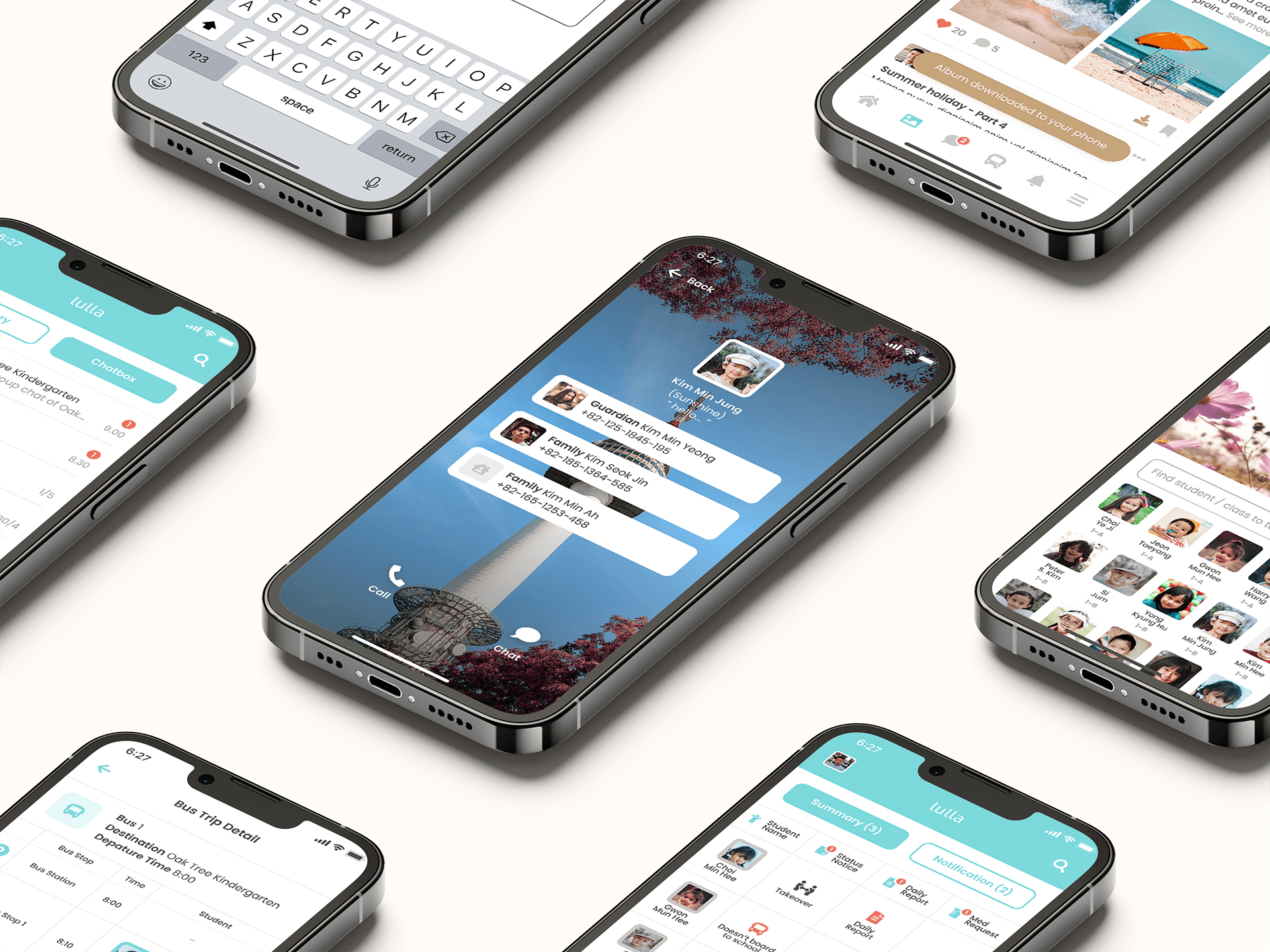
Lulla is an educational management mobile application designed to help kindergartens and elementary schools manage daily operations, communication, and student activities within a single, unified system.
The project was developed as a collaborative effort between Pharos Digital Ltd. (Vietnam) and Vida Ed Tech Ltd. (South Korea) and was planned for presentation to the Ministry of Education of South Korea. The application targets both internal school staff and external service users, including parents and guardians, each with distinct needs and access levels.
My role covered end‑to‑end UX/UI design, including system architecture, interaction design, permission logic, and visual design, with the goal of creating a scalable, role‑aware platform suitable for real‑world school environments.
Challenges
Designing Lulla involved solving complex UX and system challenges shaped by the needs of educational institutions and multiple stakeholder groups.
Diverse User Roles
The platform needed to support principals, managers, teachers, guardians, bus drivers, and aides. Each role required different permissions, visibility levels, and workflows, making a single-interface approach ineffective.
Permission & Access Control
The system required more than login access. It needed clear role-based permissions, approval flows, and principal-level control over sensitive actions such as inviting managers or assigning access.
Fragmented School Operations
Core tasks like announcements, surveys, messaging, photo sharing, and transportation were often managed through separate tools or manual processes. This created communication gaps, lost information, and added administrative workload.
Tight Timeline & Broad Scope
With limited time, UX and UI had to be developed in parallel. The challenge was creating a scalable design system that allowed fast iteration while maintaining consistency across the product.
Solution
To address these challenges, the product was designed using a modular, role‑driven system architecture, supported by clear interaction principles and a consistent visual language.
1. Modular Product Architecture
The application was divided into 8 functional modules (A–H), allowing UX and UI work to progress in parallel while maintaining clarity and scalability.
Module A: Authentication & Authorization
Module B: School Management
Module C: Announcement Newsfeed
Module D: Album Newsfeed
Module E: Messaging Channel
Module F: Bus Management
Module G: Quickview
Module H: Others / Settings
Each module was designed around specific user goals and access rules.
2. Role‑Based Access Control by Design
Instead of hiding permissions behind technical settings, access control was treated as a core UX problem.
Roles were clearly defined early in the design process
Information architecture reflected organizational hierarchy
Visual access‑control diagrams clarified which users could access which modules
High‑risk actions were gated by principal approval
This approach increased trust, reduced errors, and made the system easier to understand for school staff.
3. Workflow‑Focused Feature Design
Each key workflow was intentionally mapped to a dedicated module:
Announcements & Surveys: Centralized communication from schools to families
Albums: Media sharing with privacy controls and student tagging
Messaging: Secure, role‑aware daily communication
Bus Management: Real‑time student commute tracking
Quickview: A dashboard for time‑sensitive information such as notices and confirmations
The goal was to reduce friction, minimize redundancy, and surface the right information at the right time.
Impacts
For schools and administrators, centralized management reduced manual administrative work by an estimated 30 to 40 percent, particularly in user management and announcements.
Announcement creation and distribution became up to 50 percent faster, improving consistency and reach.
For families, mobile‑first communication drove nearly 2× higher engagement with announcements and surveys compared to traditional channels.
Real‑time bus tracking increased transportation transparency and reduced daily inquiry volume by approximately 25 percent.
Clear role‑based permissions significantly reduced access‑related errors, improving data security and operational confidence for schools.