Industry
IT & Critical Raw Materials
Client
Rovjok Oy x EIT Raw Materials
MVP: Digital twin platform for mining operations
Intro
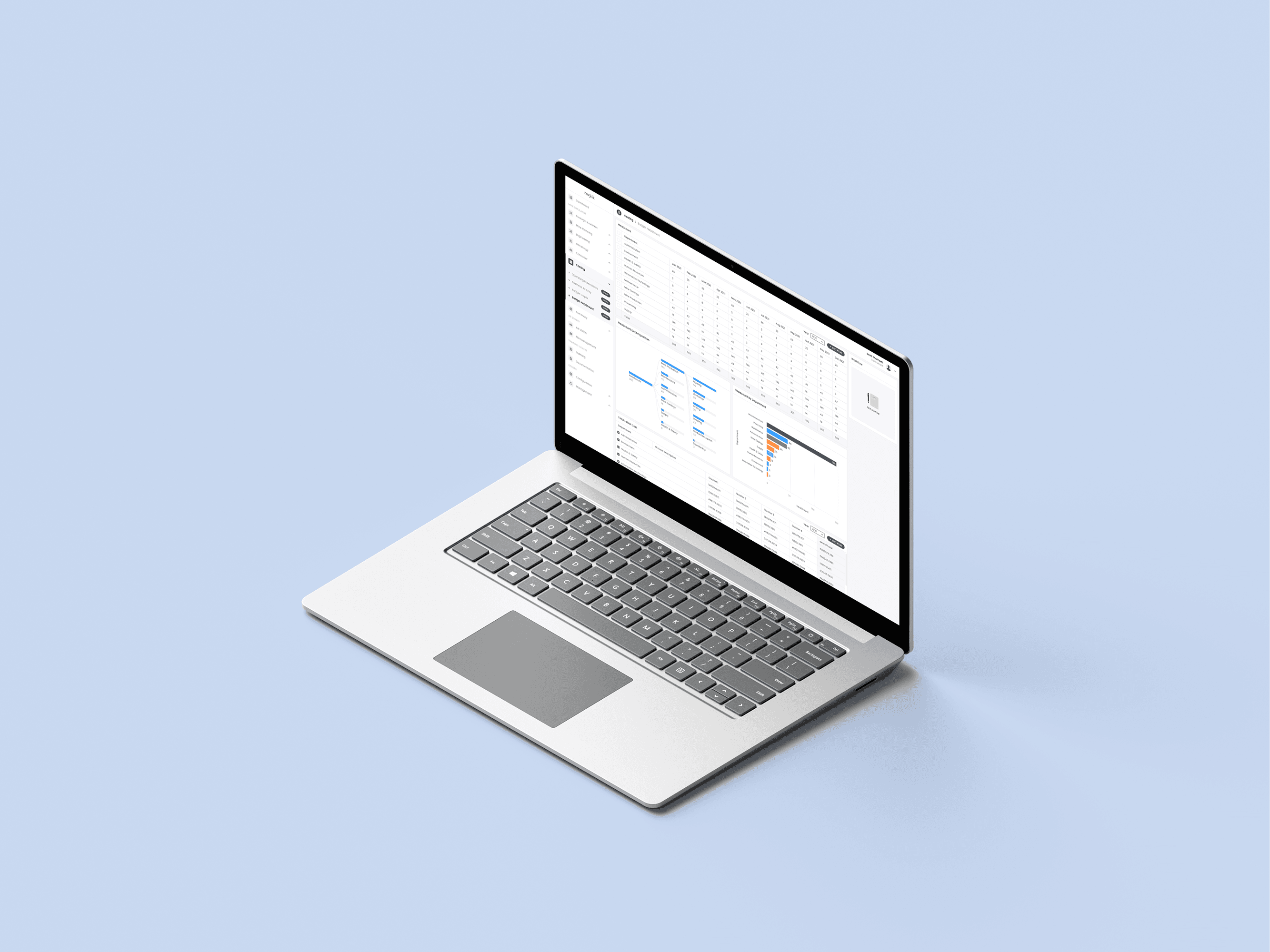
The Mine Virtual Portal is a web based digital twin platform developed for Rovjok Oy to support modern mining operations through real time visualization, scenario planning, and operational optimization. Mining environments generate vast amounts of operational, geological, and financial data across disconnected systems. Prior to this project, much of that information was fragmented, difficult to interpret, and slow to act upon.
The goal of the Mine Virtual Portal was to create a centralized, intuitive, and technically robust interface that transforms complex mining data into a shared operational understanding. The platform functions as a digital twin of the mine, combining spatial models, live operational metrics, and planning tools into a single decision making environment for managers, planners, and engineering teams.
From a UX and UI perspective, the challenge was not aesthetic innovation but cognitive clarity. The interface needed to support expert users working with dense data, high stakes decisions, and long planning horizons. My role focused on experience strategy, interaction design, information architecture, and UI system design for a product that bridges industrial engineering and human decision making.
Challenges
High Data Complexity and Domain Specificity
Mining operations involve numerous data types including production volumes, equipment status, geological layers, schedules, workforce allocation, and costs. Each dataset has its own structure, update frequency, and ownership. Traditional dashboards either oversimplified this information or exposed raw data without meaningful context.
From a UX standpoint, the challenge was designing interfaces that respect domain complexity without overwhelming users. Expert users expect precision and depth but still require visual hierarchy, progressive disclosure, and reliable mental models. A poorly structured interface would slow decisions rather than accelerate them.
Lack of a Shared Mental Model Across Stakeholders
Different roles within mining operations interpret the same data differently. Executives focus on budgets and high level KPIs, planners focus on schedules and constraints, and engineers focus on asset level performance. Prior tools forced users into isolated views, preventing collaborative understanding.
The portal needed to act as a shared visual language across roles. The digital twin had to anchor abstract numbers to spatial and temporal representations of the mine so that decisions could be discussed using the same reference point.
Real Time Data Trust and Transparency
Live operational data introduces a trust problem. Users need to understand where data comes from, how recent it is, and how confident they should be in acting on it. Any lag, inconsistency, or unexplained discrepancy undermines credibility.
This required careful UX treatment of timestamps, data states, loading behavior, and system feedback. The interface needed to make uncertainty visible without creating alarm or confusion.
Scenario Planning Without Cognitive Overload
One of the key product goals was enabling scenario modeling for operational strategies and budget impacts. Scenario planning tools often fail because they expose too many parameters at once or hide assumptions behind complex forms.
The challenge was to design scenario workflows that allow users to ask meaningful what if questions while preserving clarity, traceability, and comparability between scenarios.
Limited Visual Assets and System Evolution
The product was developed alongside evolving technical capabilities. Screens and components changed frequently, which made traditional screenshot driven UI communication unreliable. The UX system needed to be flexible, modular, and conceptually strong enough to scale as new data sources and features were introduced.
Solution
1. Digital Twin as the Primary Navigation Paradigm
The core UX decision was to make the digital twin the cognitive and navigational center of the platform rather than a decorative visualization. Spatial representations of the mine function as an information map where users can explore assets, zones, and activities.
Instead of navigating through menu heavy dashboards, users interact with the mine model itself. Selecting a location, asset, or time range reveals relevant operational, financial, and planning data in contextual panels. This spatial anchoring reduces abstraction and improves comprehension, especially for cross functional discussions.
2. Layered Information Architecture
To manage complexity, the interface follows a layered information strategy. High level indicators present system health, production status, and key risks at a glance. More detailed metrics are revealed progressively through interaction rather than immediate exposure.
For example, asset level views show summary performance first, with deeper diagnostic data accessible through secondary panels or drill downs. This respects expert users while avoiding unnecessary noise during routine monitoring.
3. Modular UI System for Industrial Data
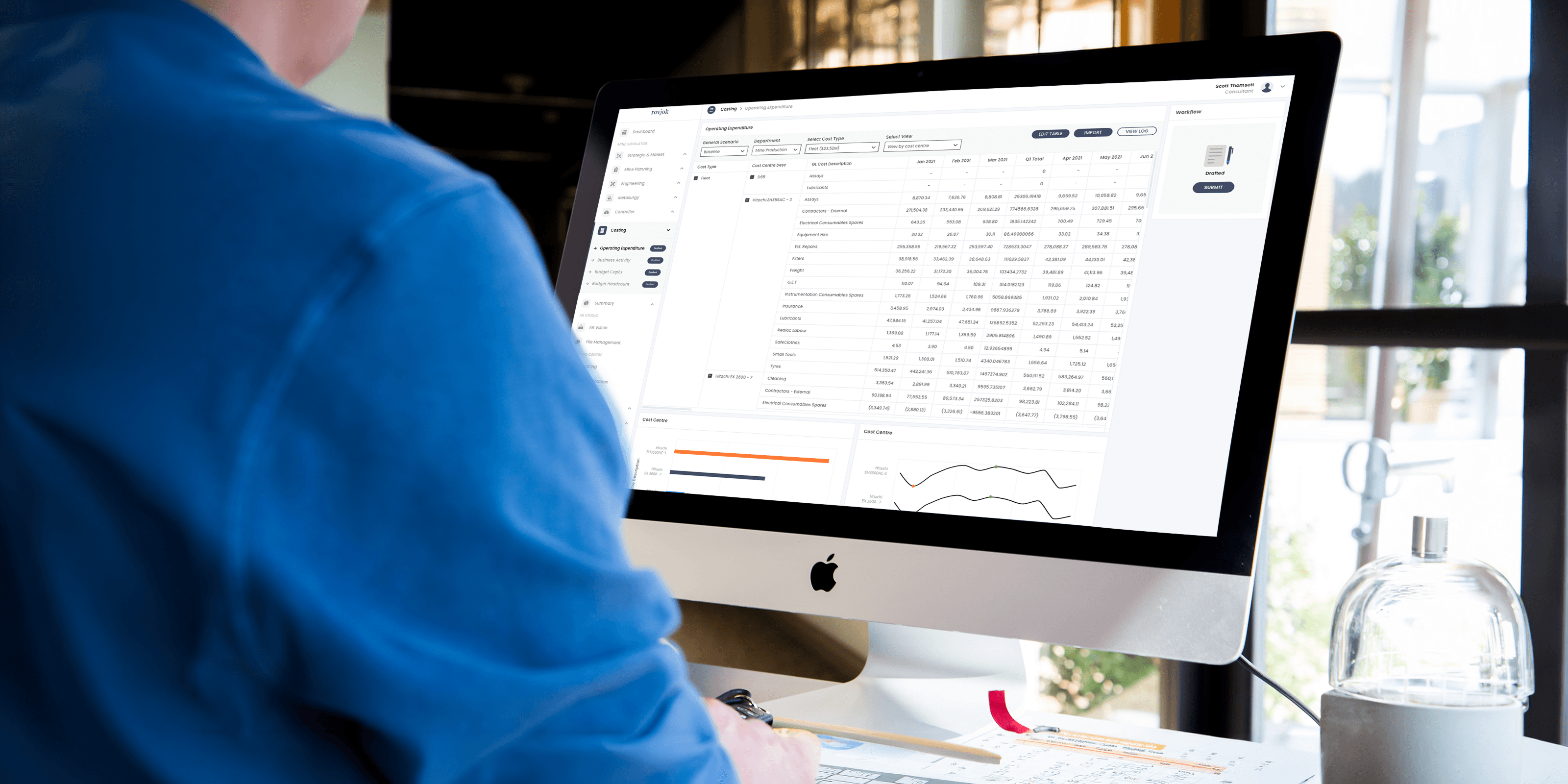
A consistent UI component system was designed to handle diverse data types including time series charts, tables, spatial overlays, and scenario controls. Visual consistency was prioritized over novelty to support fast scanning and reduce cognitive load over long sessions.
Color usage was restrained and functional. Colors indicate state, deviation, or priority rather than decoration. Typography choices emphasize legibility at dense information scales, supporting prolonged usage in professional contexts.
4. Scenario Planning Through Comparative Views
Scenario modeling was designed around comparison rather than isolated simulation. Users can create alternative operational strategies, adjust parameters such as production rates or equipment allocation, and immediately compare projected outcomes.
The UX emphasizes side by side and overlay comparisons across time, cost, and resource utilization. Assumptions and inputs remain visible to prevent black box effects. This design supports data driven discussions and risk assessment before implementation.
5. Interaction Feedback and Data Confidence Indicators
To increase trust in live data, the interface communicates system state clearly. Data freshness, synchronization status, and calculation updates are visible within the UI. Loading states are informative rather than generic, helping users understand whether delays are technical or data related.
This transparency is critical in environments where decisions have real operational and financial consequences.
Impacts
Single Source of Truth for Mining Operations
The Mine Virtual Portal established a unified operational view where previously data was siloed across systems and reports. The digital twin functions as a shared reference that aligns stakeholders around the same real time information.
This reduced reliance on manual status reporting and ad hoc data reconciliation, accelerating decision cycles.
Improved Decision Quality and Speed
By combining spatial context, live metrics, and scenario modeling, users can move from observation to action more efficiently. Operational risks and budget implications become visible earlier, allowing proactive rather than reactive management.
Scenario planning enables teams to test strategies digitally before committing resources in the physical mine environment.
Reduced Cognitive Load for Expert Users
The layered interface design and spatial grounding significantly improve usability in a data heavy domain. Users can focus on relevant information without losing access to deeper detail when needed.
This balance between power and clarity is especially important for expert users who interact with the platform daily.
Foundation for Data Driven Collaboration
The portal supports cross functional collaboration by aligning planning, operations, and management around a common visual and analytical framework. Discussions shift from subjective interpretation to shared, evidence based understanding.
Long Term Product Value
Beyond immediate operational benefits, the UX and UI system provides a foundation for continued innovation. As digital twin technology, automation, and predictive analytics mature, the platform is positioned to integrate new capabilities without requiring a fundamental redesign.