Industry
Critical Minerals & Supply Chain Intelligence
Client
Rovjok Oy
Supply Monitor: Supply chain intelligence tool
Intro
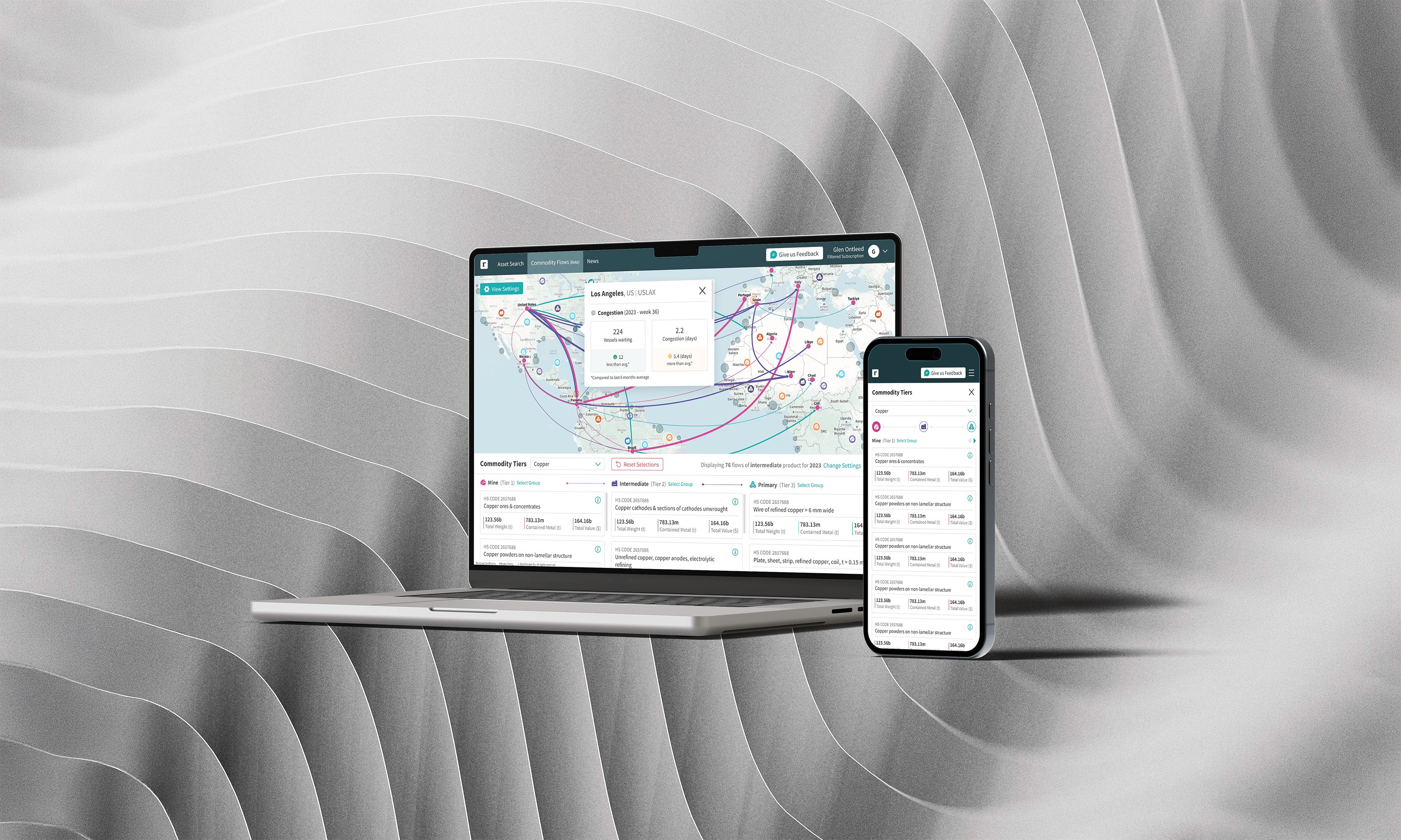
Rovjok’s Supply Monitor App is a web-based supply chain intelligence platform designed to bring transparency and real-time situational awareness to critical raw mineral supply chains. The product addresses a fundamental challenge faced by governments, mining companies, and downstream industrial stakeholders: understanding where materials originate, how they move, and what risks threaten them across a fragmented global landscape.
The app forms part of Rovjok’s broader analytics ecosystem, mapping suppliers, assets, trade flows, and events related to critical minerals such as copper, nickel, and lithium. The UX challenge was significant: translating complex, multi-layered supply chain data, often abstract and technical, into a usable, decision‑oriented interface that supports risk identification, exploration, and monitoring in near real time.
From the outset, the design goal was not to simplify the domain, but to make complexity navigable and support expert users without overwhelming them.
Challenges
Visualising Complex, Multi‑Tier Supply Chains
Critical mineral supply chains span multiple tiers like mines, processors, ports, traders, and downstream consumers, distributed across continents. Traditional dashboards struggle to represent:
Non-linear flows of material
Cross-border dependencies
Intersections between physical assets, events, and geopolitical context
The UX challenge was to design a system-level view that communicates relationships and risk propagation without flattening or oversimplifying the data.
Cognitive Load for Expert Users
The primary users are supply chain analysts, policy advisors, and risk managers. They are domain experts, but they operate under time pressure. They need to:
Identify disruptions quickly
Validate signals with contextual data
Drill down from macro patterns to asset-level detail
This required careful balancing:
high data density with low interaction friction.
A major UX risk was creating an interface where insights were technically present, but practically undiscoverable due to poor information hierarchy.
Integrating Real‑Time Events Into Static Structures
News, weather events, sanctions, and operational disruptions constantly reshape supply chain risk. However:
Events are transient
Assets and trade routes are persistent
The relationship between the two is contextual
The design challenge was to anchor dynamic information (events, alerts, news) onto a stable mental model of the supply chain so users could understand “what changed” and “why it matters” within seconds.
Mapping Without Becoming a Map Tool
While geographic visualisation is critical, the product could not degrade into a generic GIS experience. The map needed to be:
Analytical, not decorative
A means of reasoning, not exploration alone
Integrated with tabular and comparative data
This required careful UX decisions around layering, filtering, and progressive disclosure.
Solution
1. Information Architecture & Mental Models
The core UX concept was to align the application’s structure with how experts think about supply chains, not how databases store them.
The platform was organised around three primary mental models:
Assets & Suppliers – “Where does material come from?”
Flows & Trade Routes – “How does material move?”
Events & Risks – “What could disrupt it?”
Rather than forcing users into rigid workflows, the UI supports fluid movement between these perspectives, allowing users to pivot from a high-level overview into focused analysis in context.
2. Map‑Centric, Data‑Augmented Interface
The main interface uses a map as the anchor, but not the sole carrier of information. The map is augmented with:
Trade flow lines with varying visual weight
Asset-level nodes (mines, ports, hubs)
Contextual overlays for events and disruptions
To prevent visual overload:
Commodity tiers and routes are selectively enabled
Filters act as intentional constraints, not just data toggles
Spatial interactions are paired with side panels containing structured data
This dual‑channel layout (spatial + analytical) allows users to reason visually while validating insights numerically.
3. Progressive Disclosure & Interaction Design
Given the depth of available data, the UI relies heavily on progressive disclosure:
Tooltips and hover states reveal summaries
Click interactions open structured detail cards
Deeper analysis is deferred until explicitly requested
This interaction model reduces cognitive load while preserving expert depth.Users are never blocked from detail, but are never forced into it prematurely.
Micro-interactions were designed to reinforce cause‑and‑effect:
Selecting a flow highlights related assets
Selecting an event surfaces impacted routes and suppliers
Commodity switching reconfigures the entire visual context
4. Visual Hierarchy & Data Legibility
The visual design prioritises contrast, hierarchy, and neutrality:
Muted base colours establish a calm background
High-signal elements (alerts, disruptions, critical routes) use controlled accent tones
Typography is compact and data‑first, optimised for scanning
This ensures that critical signals stand out without visual noise, supporting long analytical sessions without fatigue.
5. Consistency, Scale, and Technical Constraints
The app was built as a React-based web platform, which influenced design decisions around:
Component reuse and scalability
Predictable UI patterns for data tables, filters, and overlays
Future extensibility as new data sources and commodities are added
Design systems thinking was applied even with a small screenshot footprint, establishing patterns that scale naturally as the platform evolves.
Impacts
Improved Situational Awareness
The Supply Monitor App enables users to detect and contextualise supply chain risk in near real time, reducing reliance on fragmented external data sources. By unifying assets, flows, and events, users gain a single operational picture of complex supply networks.
Faster, More Confident Decision‑Making
The UX allows users to move from signal to insight rapidly:
Identify a disruption
Understand its geographic and commodity context
Assess potential downstream impact
This reduces analysis time and supports proactive risk mitigation instead of reactive response.
Scalable Foundation for Advanced Intelligence
The interaction patterns and information architecture established in Supply Monitor provide a foundation for:
Advanced forecasting
Scenario analysis
Policy and compliance‑driven evaluation
By designing for scale and complexity from the start, the platform can evolve without fundamental UX rework.
Positioning Rovjok as a Design‑Led Intelligence Platform
Beyond function, the product reinforces Rovjok’s positioning as a serious, data‑driven intelligence partner in the critical minerals space. The UX communicates credibility, rigor, and clarity—key trust signals for decision‑makers operating in high‑risk environments.